
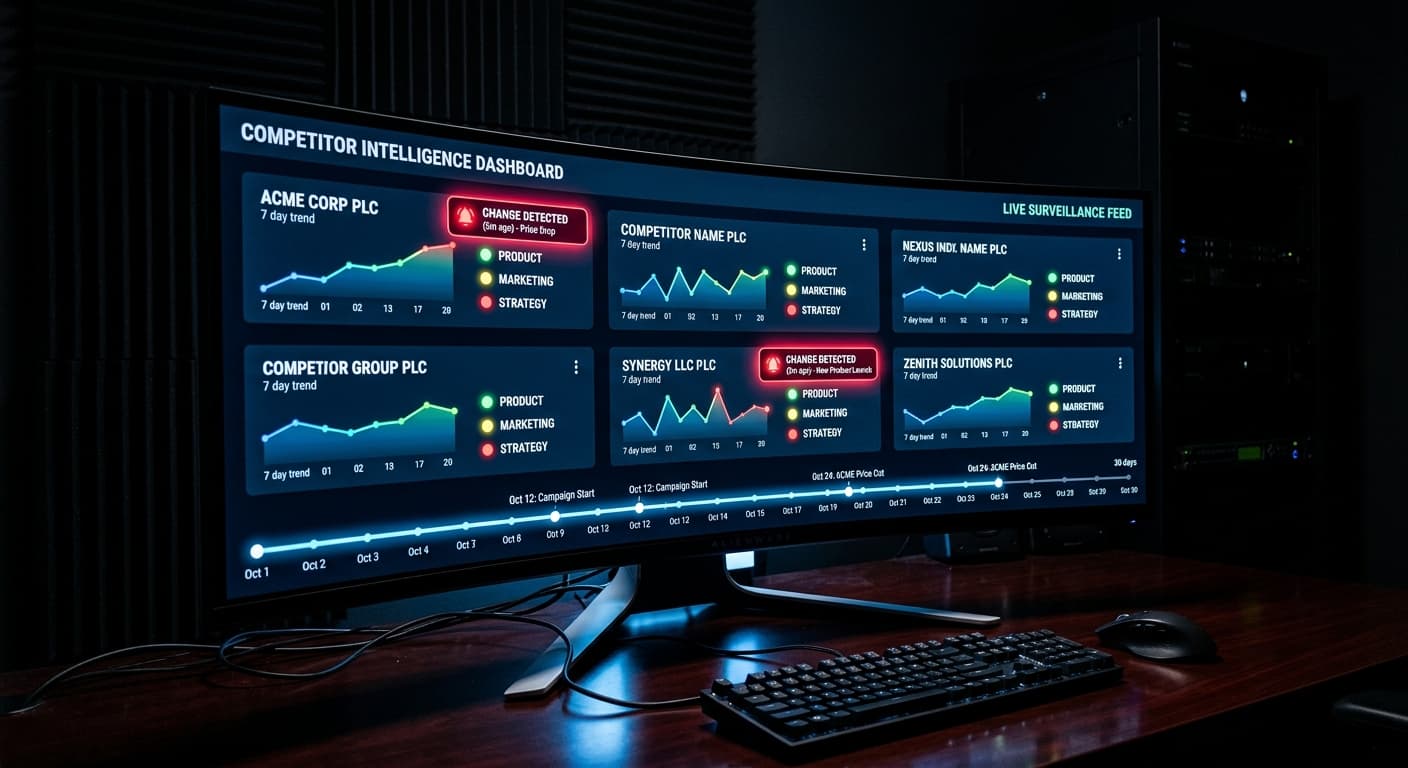
Knowing what your competitors are doing used to mean spending hours every week manually checking their websites, scrolling through their social media, reading their reviews, and trying to spot changes in their advertising. Most business owners know this is important. Almost none of them actually do it consistently because who has the time.
We built systems that do it automatically. Not as a product we sell, but as internal tools we use for our clients and our own business. Here is what those systems look like, what they monitor, and how you can start building your own version.
What We Monitor and Why
Ad copy and creative changes. When a competitor changes their Google Ads headline, adjusts their offer, or launches a new campaign, we want to know about it within hours, not weeks. Shifts in competitor advertising often signal strategic changes: new services, pricing adjustments, or targeting new customer segments. Catching these early gives our clients time to respond.
Website content changes. New service pages, pricing updates, team changes, and blog posts all tell a story about where a competitor is headed. A competitor suddenly publishing content about a service they never offered before? That is a signal worth paying attention to.
Review sentiment trends. Individual reviews are noise. Trends in review sentiment are signal. If a competitor's average rating drops from 4.5 to 3.8 over three months, something changed in their operations. If their reviews suddenly spike, they may have launched a review campaign. Both are useful to know.
Pricing movements. For industries where pricing is visible (SaaS, ecommerce, some service businesses), tracking competitor pricing changes helps you stay competitive without constantly checking manually.
Search ranking shifts. When a competitor starts ranking for keywords they previously did not appear for, it usually means they have invested in content or SEO for that term. Understanding what they are targeting helps you decide whether to compete for those same terms or focus elsewhere.
How the System Works
The architecture is simpler than most people assume. There are three layers:
Data collection. Automated systems visit competitor websites, ad platforms, and review sites on a scheduled basis. For websites, this means fetching and storing page content at regular intervals so changes can be detected by comparing the current version to the previous one. For reviews, it means monitoring platforms for new entries.
Analysis. Raw data is not useful. AI processes the collected data to extract meaningful changes. A new paragraph on a competitor's pricing page is flagged and summarized. A shift in review sentiment is calculated and reported as a trend. A new ad creative is captured and compared against their previous messaging.
Reporting. Results are compiled into a summary that highlights what changed, when it changed, and why it might matter. This report lands in Slack or email without anyone asking for it.
The key design principle is that nobody should have to remember to check anything. The system runs on its own schedule, and humans only engage when something worth acting on appears. If you are interested in building focused AI automations like this, our workflow guide covers the principles we use to design these systems.
What We Have Learned From Running This
After running competitive intelligence systems for months across multiple client verticals, a few patterns have emerged:
Most competitors change less than you think. The fear that competitors are constantly innovating and outmaneuvering you is usually overblown. Most businesses update their website a few times per quarter, adjust ads monthly, and rarely make dramatic strategic shifts. Knowing this is itself valuable because it tells you where the opportunity is.
Small changes often signal big moves. A competitor adding a single new service page is a small change. But if that page targets a keyword with high commercial intent in your market, it could represent the start of a significant competitive push. The system catches these early.
Review trends are the most actionable data. Knowing that a competitor's customer satisfaction is declining gives you a clear opportunity to target their unhappy customers with your marketing. Knowing that their reviews are surging tells you they are investing in reputation management and you might need to as well.
Consistency beats depth. Checking competitors superficially every day is more valuable than doing a deep analysis once per quarter. The daily checks catch changes in real time. The quarterly deep dive often reveals things that were true months ago and are no longer actionable.
What You Can Build Yourself
You do not need custom infrastructure to start monitoring competitors. Here is a practical starting point:
Google Alerts. Set up alerts for each competitor's brand name. You will receive an email whenever they are mentioned online. This is free and takes five minutes.
Social media monitoring. Follow all competitors on every platform they use. Turn on post notifications for their accounts. This gives you real time visibility into their content strategy.
Review monitoring. Bookmark their Google Business Profile, Yelp, and any industry specific review platforms. Check them weekly. Even better, use a tool like ReviewTrackers or BirdEye that aggregates reviews across platforms and sends you alerts.
Website change detection. Tools like Visualping or ChangeTower will monitor specific pages on competitor websites and notify you when content changes. Set these up on their homepage, pricing page, and service pages.
Ad transparency tools. Google Ads Transparency Center lets you see what ads any business is currently running on Google. Meta Ad Library does the same for Facebook and Instagram ads. Check these monthly to see what competitors are spending money to promote.
These manual and semi automated approaches will not match the depth of a fully automated system, but they will give you 80 percent of the competitive intelligence value with minimal investment.
The Strategic Value
Competitive intelligence is not about copying what competitors do. It is about making informed decisions. When you know what the market is doing, you can identify gaps they are not filling, opportunities they are not pursuing, and weaknesses you can exploit.
We have used competitive monitoring data to help clients launch services their competitors were not offering, target customer segments their competitors were neglecting, and adjust pricing strategies based on market movements they would not have noticed otherwise.
The businesses that consistently outperform their competitors are not always smarter or better funded. They are often just better informed.
If you want help setting up competitive monitoring for your business or industry, whether that is a simple alert system or a fully automated intelligence pipeline, we build these.