Every phone heavy business has the same problem. Someone calls. Your team talks to them. The call ends. And then the information from that call exists in exactly one place: the memory of the person who answered the phone.
Maybe they scribble a note on a sticky pad. Maybe they type something into the CRM if they have time before the next call rings. Maybe they remember the important details. Maybe they forget. Maybe they are out sick tomorrow and the client calls back and whoever answers has zero context about the previous conversation.
This is not a technology problem. Phones have existed for over a century. CRMs have existed for decades. The gap is not in the systems. It is in the space between the systems. The moment between when a call ends and when the information from that call gets recorded, categorized, and made available to the rest of the team.
We built a system that closes that gap in under 60 seconds.
The Problem We Were Solving
One of our clients, a small business with eight employees, was handling hundreds of calls per week across their RingCentral phone system. The calls covered everything: new quotes, policy questions, claims, renewals, billing disputes, carrier follow ups, and general inquiries.
The team was good on the phone. They knew their clients. They gave solid advice. But the documentation was a disaster.
Call notes were inconsistent. Some agents typed detailed summaries after every call. Some typed a few words. Some typed nothing. The CRM had gaps everywhere. If a client called three times over two weeks, there might be notes for one of those calls.
The real pain showed up in handoffs. When a client called back and got a different team member, that person had to start from scratch. "Can you remind me what we discussed last time?" is a question that erodes trust with every repetition. The client already told you. They should not have to tell you again.
The owner estimated his team spent 2 to 3 hours per day collectively on post call documentation. And even with that effort, the documentation was incomplete.
What We Built
The system has four stages. Each one runs automatically after every call with no human intervention required.
### Stage 1: Call Recording Capture
The business already had call recording enabled through RingCentral. Most business phone systems offer this. The recordings were being stored but nobody was doing anything with them. They existed as a compliance archive that someone might dig through if there was a dispute, but they were not contributing to daily operations.
We built a listener that detects new call recordings as they become available through the phone system's API. When a call ends and the recording is ready, the system picks it up automatically. No manual export. No downloading files. The pipeline starts within seconds of the call ending.
### Stage 2: AI Transcription
The recording gets sent to a speech to text model running on our own hardware. Not a cloud service. Not an API that sends your client conversations to a third party server. A model running on a GPU in a machine we physically control, connected to the business's systems through an encrypted private network.
This matters for two reasons. First, privacy. Business calls contain sensitive personal information: account numbers, claim details, financial data. Sending that to a cloud transcription service means that data touches third party infrastructure. Running the model locally means the audio never leaves the network.
Second, speed. Cloud transcription services typically return results in 30 seconds to several minutes depending on call length and queue depth. Our local system processes a 10 minute call in under 15 seconds. A 30 minute call in under 45 seconds. The transcription is ready before the agent has finished their post call notes.
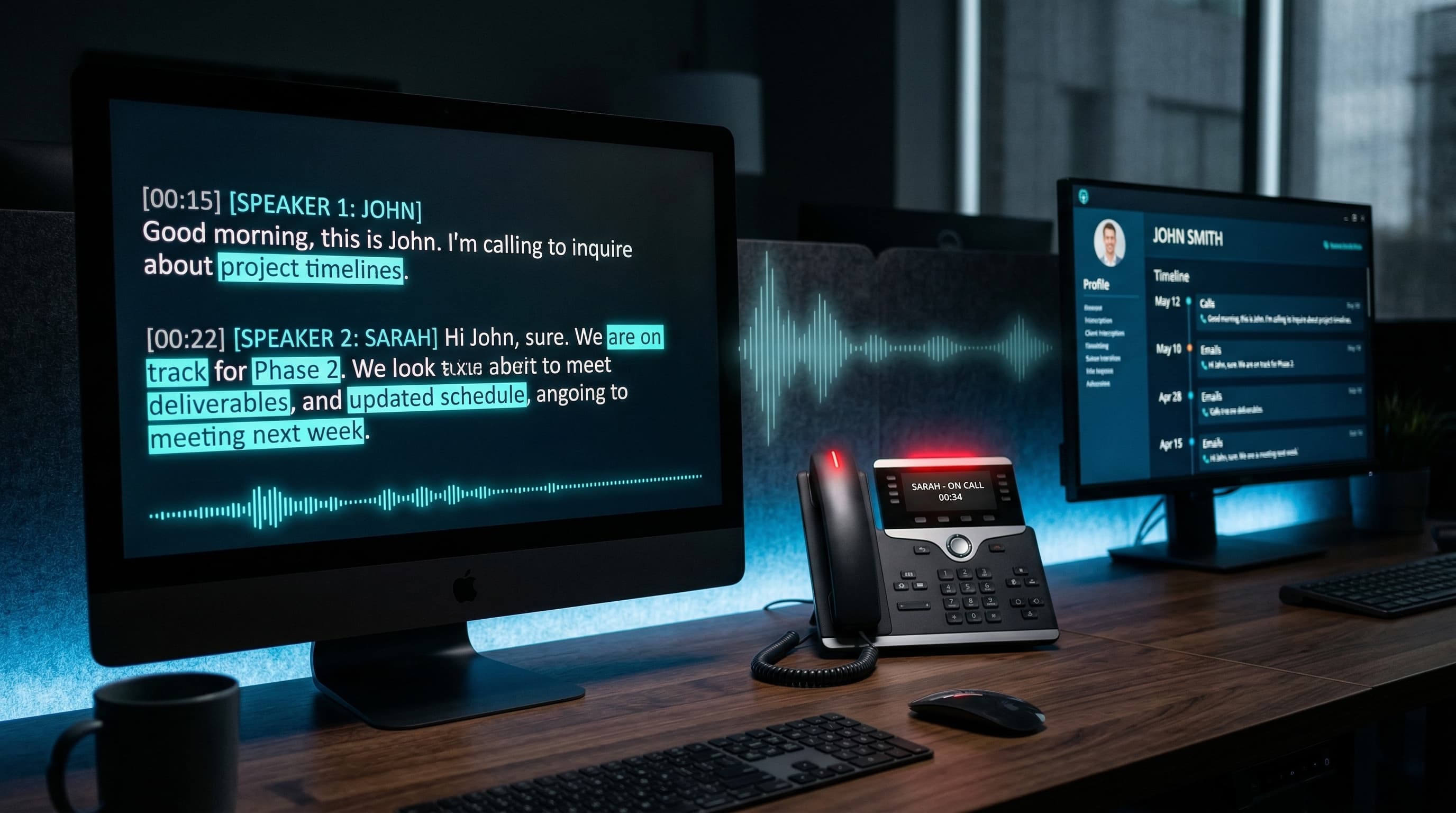
The transcription model handles multiple speakers, identifies who is talking (agent versus caller), timestamps the conversation, and produces a clean text output with speaker labels.
### Stage 3: AI Summarization
A raw transcription of a 15 minute phone call is several pages of text. Nobody wants to read that. The team needs the essential information extracted and organized.
A second AI model reads the transcription and produces a structured summary. Not a generic "this call was about a question." A structured extraction that pulls out:
Who called. The caller's name and phone number, matched against the CRM if they are an existing client.
What they needed. The primary reason for the call, categorized by type: new inquiry, account change, billing question, follow up discussion, general inquiry.
What was discussed. The key points of the conversation. Specific account numbers mentioned. Specific questions asked. Specific amounts or dates referenced. Commitments made by either party.
What needs to happen next. Action items extracted from the conversation. "Agent promised to send information by Thursday." "Client needs to provide their updated contact details." "Follow up scheduled for next week."
Sentiment and priority. Was the caller frustrated? Satisfied? Confused? In a hurry? This context helps the team understand not just what was said but how the interaction went.
The summarization model runs on the same local infrastructure as the transcription. Same privacy guarantees. Same speed. The summary is typically ready within 10 to 15 seconds after the transcription completes.
### Stage 4: Integration and Distribution
The summary gets pushed into the business's operations dashboard and linked to the client record. If the caller is an existing client, the summary appears in their unified timeline alongside their emails, previous calls, and tasks. If the caller is a new lead, a new record is created with the call as the first touchpoint.
Action items from the call are automatically converted into tasks in the CRM, assigned to the agent who handled the call, with due dates based on any commitments mentioned in the conversation.
The agent who took the call gets a notification with the summary. They can review it, make corrections if the AI misunderstood something, and approve it. This review step takes 30 seconds instead of the 5 to 10 minutes they used to spend writing notes from memory.
The entire pipeline from call ending to summary appearing in the dashboard takes under 60 seconds.
What Changed Immediately
The impact was visible within the first week.
Post call documentation time dropped from 2 to 3 hours per day to about 20 minutes. The team went from writing summaries from memory to reviewing AI generated summaries and making minor corrections. The quality of the documentation actually improved because the AI captures details that humans forget or skip over.
Handoffs stopped being painful. When a client called back and got a different team member, that person could see the full summary of every previous interaction in seconds. "I see you called Tuesday and Sarah was looking into options for you. Let me check where that stands." That kind of continuity builds trust.
Missed follow ups dropped dramatically. Before the system, follow up items lived in individual agents' heads or on sticky notes. Now they are automatically extracted and tracked as tasks with deadlines. If an agent promised to send something by Thursday and Thursday arrives without it being marked as sent, the system flags it.
The owner got visibility he never had before. He could see call volume patterns, common call reasons, average call duration by type, and team performance metrics. He discovered that 40% of calls on Monday mornings were clients checking on things that should have been communicated proactively the previous Friday. That insight led to a new end of week client communication workflow that reduced Monday morning call volume by over 25%.
The Technical Details That Matter
For anyone considering building something similar, here are the technical decisions that made the biggest difference.
Local processing is non negotiable for sensitive industries. Insurance, healthcare, legal, financial services. Any industry where calls contain regulated personal information should not be sending audio to cloud transcription APIs unless they have explicitly verified that the provider's data handling meets their compliance requirements. Running the models locally eliminates that entire category of risk.
The summarization model matters more than the transcription model. Transcription technology is mature. Most modern speech to text models produce good results. Where the real value lives is in the summarization layer. The ability to extract structured data (caller intent, action items, sentiment) from raw conversation text is what transforms a transcription from a long document nobody reads into an operational tool the team actually uses.
Speaker identification is essential. A transcription that does not distinguish between the agent and the caller is dramatically less useful. Knowing who said what is the difference between "a request was made" and "the caller requested specific information and the agent committed to providing three options by Wednesday."
The review step is not optional. AI transcription and summarization are good but not perfect. Names get misspelled. Numbers occasionally get transposed. Context that is obvious to a human listener can be misinterpreted by the model. The human review step catches these errors and also gives the team a sense of ownership over the documentation. They are approving it, not just trusting it blindly.
Integration with existing systems is the whole point. A standalone call transcription tool that lives in its own app is a novelty. A system that feeds directly into the CRM, the client record, and the task management workflow is an operational upgrade. The transcription has to live where the team already works or they will stop looking at it within a month.
Who This Works For
This system was built for a service business, but the pattern applies to any company where phone calls are a significant part of operations.
Dental and medical practices. Patient calls about appointments, symptoms, insurance questions, and follow ups. The documentation requirements are even higher due to medical record keeping standards.
Law firms. Client intake calls, case updates, opposing counsel conversations. Lawyers bill by the hour and need accurate records of every interaction. Automated call intelligence eliminates the "I forgot to note that detail" problem.
Real estate agencies. Buyer inquiries, seller updates, contractor coordination, lender communication. Real estate transactions involve dozens of calls per deal. Missing a detail from one call can delay a closing.
Home services businesses. Plumbers, electricians, HVAC companies. Dispatchers taking service calls need to capture the problem description, location, urgency, and customer history accurately. A missed detail means a truck rolls to the wrong address or without the right equipment.
Any business with a sales team. Every sales call contains information that should feed back into the CRM: what the prospect cares about, what objections they raised, what the next step is, when to follow up. Most of that information evaporates after the call.
The Cost Reality
We are not going to pretend this is free. Running AI models on dedicated hardware has real costs. The GPU capable machine. The electricity. The network infrastructure. The development time to build the pipeline and integrate it with existing systems.
For most small businesses, the build cost is justified when you calculate the time savings. If your team of 8 spends 2 hours per day on post call documentation at an average loaded cost of $30 per hour, that is $60 per day, $300 per week, over $15,000 per year. A system that reduces that by 80% pays for itself quickly.
The ongoing operational cost is primarily electricity and maintenance. There are no per call API fees because the processing happens locally. Whether you process 50 calls a day or 500, the marginal cost is the same.
For businesses that cannot justify dedicated hardware, cloud based transcription services exist at roughly $0.01 to $0.05 per minute of audio. A 10 minute call costs 10 to 50 cents to transcribe. At 50 calls per day, that is $5 to $25 per day in transcription costs. Reasonable, but the privacy tradeoffs need to be evaluated based on your industry's requirements.
What We Would Build Differently Today
Every system teaches you something. Here is what we would adjust if we were starting from scratch.
We would add real time transcription during the call, not just post call processing. The technology supports it. Imagine the agent seeing a live summary building on their screen while they are still on the phone. Key details highlighted. CRM record pulled up automatically based on caller ID. Suggested responses based on the conversation context. That is the next version.
We would build the sentiment analysis deeper. Not just "frustrated" or "satisfied" but tracking sentiment shifts within the call. A client who starts angry and ends satisfied is a success story. A client who starts neutral and ends confused is a training opportunity. That granularity is valuable for coaching and quality assurance.
We would add automated quality scoring. Did the agent greet the caller by name? Did they verify the account number? Did they summarize next steps before ending the call? These are measurable behaviors that can be tracked automatically and used for team development without requiring a manager to listen to recordings manually.
---
Want a Call Intelligence System for Your Business?
Every phone heavy business is sitting on a goldmine of unstructured data in their call recordings. The technology to turn those recordings into operational intelligence exists today and costs less than you think.
Book a free consultation and we will assess your phone system, call volume, and compliance requirements to determine exactly what a call intelligence pipeline would look like for your business.