
Last month, a prospective client asked us a question that every business should be asking their AI vendor: "Where does my data go when your system processes it?" We answered in one sentence: nowhere. It stays on our hardware, on our network, and never touches a third party server. The client signed that week. Their previous vendor could not give the same answer.
Running AI inference on local hardware instead of cloud APIs is not a philosophical stance. It is a business decision driven by three factors: privacy, cost, and control. Each one independently justifies the investment. Together, they make cloud based AI processing a hard sell for any business handling sensitive data.
Argument 1: Privacy Is Not Optional
When you send data to OpenAI, Google, or any cloud AI provider, that data leaves your network. It travels across the internet to someone else's servers, gets processed by someone else's infrastructure, and is subject to someone else's data retention policies. For many businesses, this is a non starter.
Insurance agencies process claims containing Social Security numbers, medical records, and financial information. Law firms handle privileged communications that cannot be disclosed to any third party. Medical practices work with protected health information governed by HIPAA. Financial advisors manage client portfolios with personally identifiable information in every document.
For these businesses, sending customer data to a cloud AI provider is not a convenience tradeoff. It is a compliance risk. OpenAI's enterprise terms have improved, but "improved" is not the same as "eliminated." The data still leaves your network. It still travels through infrastructure you do not control. And if your regulatory framework requires you to know exactly where data resides at all times, "trust us" is not an acceptable answer.
Our infrastructure eliminates this entirely. Every AI model we run for client work operates on hardware we own, in a facility we control, on a network secured with Tailscale mesh VPN. Client data never leaves the encrypted tunnel between their systems and ours. There is no third party processor. There is no data retention policy to read because the data never goes anywhere it should not be.
For businesses with sensitive data, this is not a nice to have feature. It is a requirement. And it is a requirement that most AI vendors cannot meet because they are reselling cloud API calls and marking them up.
We detailed the performance benchmarks of our inference hardware in our RTX 5090 benchmark post. The short version: local inference is not just more private. It is fast enough for production workloads.
Argument 2: Cost at Scale Makes Cloud Unsustainable
Cloud AI pricing looks reasonable when you are processing 10 documents a month. It looks very different when you are processing 1,000.
Let us run the numbers for a common workload: document processing for an insurance agency. Each document requires text extraction, classification, entity recognition, and summarization. On average, a single document consumes approximately 4,000 input tokens and generates approximately 1,500 output tokens across all processing steps.
Cloud pricing for 1,000 documents per month (using GPT 4o as baseline):
- Input tokens: 4,000,000 at $2.50 per million = $10.00
- Output tokens: 1,500,000 at $10.00 per million = $15.00
- Monthly cost: $25.00
That looks cheap. But this is a simplified example. Real workloads involve multiple passes, context windows for cross referencing, and follow up queries. A realistic estimate for production document processing with a capable cloud model runs $200 to $500 per month for 1,000 documents when you account for all the API calls that a real pipeline generates.
Now add call transcription. An agency processing 500 calls per month at an average of 8 minutes each generates roughly 4,000 minutes of audio monthly. Cloud transcription services charge $0.006 to $0.02 per second. That is $1,440 to $4,800 per month just for transcription, before any analysis or extraction.
Then add the AI analysis on top of each transcript: extracting action items, identifying policy details, generating summaries. Another few hundred dollars monthly.
Local infrastructure cost for the same workload:
Our dual RTX 5090 workstation runs Whisper for transcription at faster than real time speeds and qwen2.5 for text processing at 160 tokens per second. The hardware cost was a one time capital expenditure. The ongoing cost is electricity, which runs approximately $45 per month for the inference hardware under typical load.
Monthly cost for processing 1,000 documents and 500 calls: $45 in electricity. No per token fees. No per minute charges. No usage tiers. No surprise bills when volume spikes.
The hardware pays for itself within months, and every month after that is essentially free inference. For businesses with growing workloads, the economics only get more favorable over time. More volume means more savings compared to cloud, while the local hardware cost stays flat.
We covered the cooling solution that makes sustained heavy inference possible in our water cooling ROI analysis. Keeping dual 5090s under load 24/7 requires proper thermal management, and the investment in water cooling pays for itself in hardware longevity alone.
Argument 3: Control Means No Surprises
Cloud AI providers change their pricing, deprecate models, modify rate limits, and update terms of service on their own schedule. You find out when it happens, not before. If your business depends on a specific model for a specific workflow, you are one deprecation notice away from a scramble.
We have lived through this. OpenAI deprecated models with weeks of notice. Google changed Gemini pricing tiers mid quarter. Anthropic adjusted rate limits that broke production pipelines. Every time, the solution was the same: scramble to test alternatives, update integrations, and hope nothing breaks in production.
On local hardware, none of this happens. We choose which models to run. We decide when to upgrade. We control the versions, the configurations, and the performance characteristics. If a new model is better, we evaluate it on our own timeline and deploy it when we are confident it works. If it is not better, we keep running what works.
This control extends to fine tuning. Cloud providers offer limited fine tuning capabilities with restrictions on data handling, model access, and deployment options. On our own hardware, we can fine tune any open source model on client specific data, deploy it immediately, and iterate without waiting for API access or paying fine tuning fees.
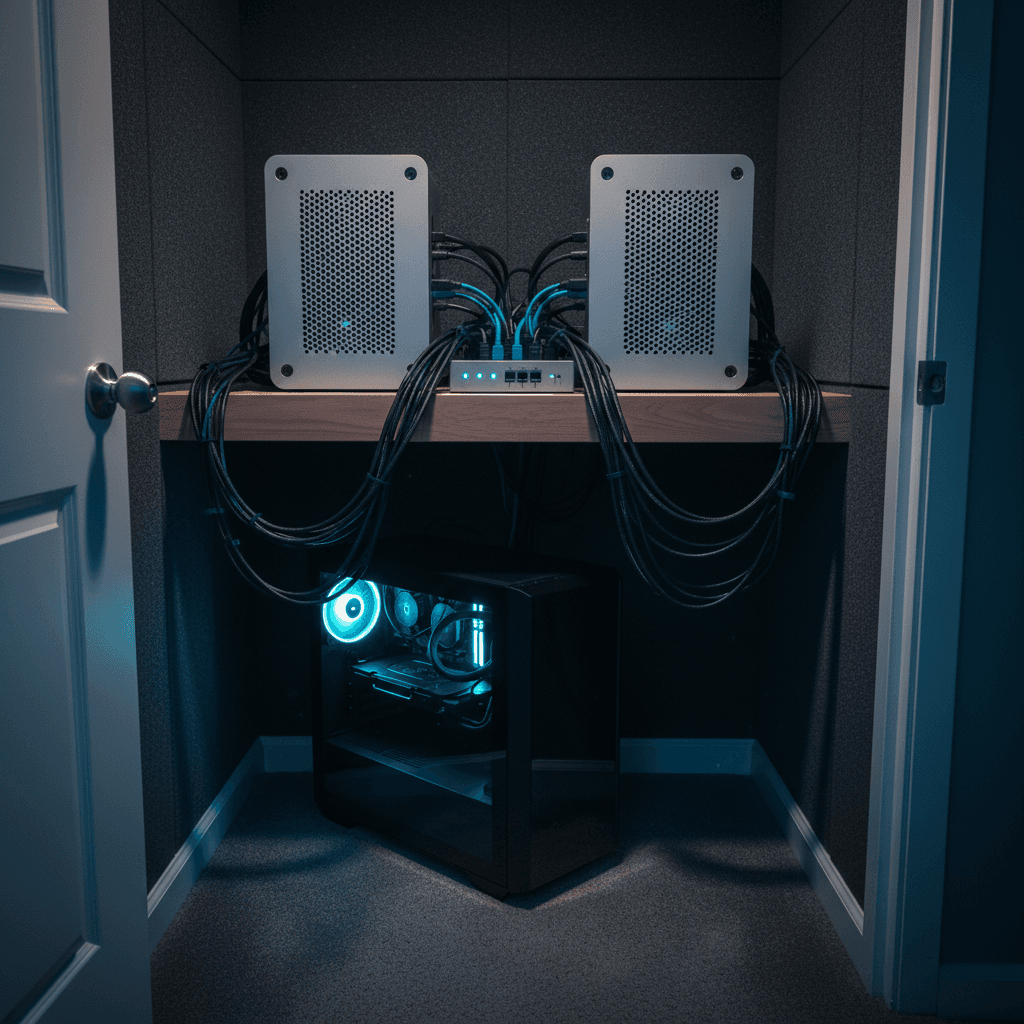
The architecture at a high level: two Mac Studios handle orchestration, scheduling, and lightweight tasks. A dual RTX 5090 workstation with 64GB of combined VRAM handles all heavy inference: transcription, document processing, text generation, image analysis, and embedding generation. Everything communicates over an encrypted Tailscale mesh VPN. All services run in Docker containers with automated health monitoring and restart capabilities.
This is not a hobby setup. It is production infrastructure that processes thousands of documents and calls monthly for real businesses with real compliance requirements.
The Question Every Business Should Ask
The next time an AI vendor pitches you a solution, ask them one question: where does my data go?
If the answer involves phrases like "our cloud partner," "industry standard encryption in transit," or "we take privacy seriously," that means your data is leaving your control. It is being sent to a third party server, processed on infrastructure you cannot audit, and subject to policies you did not write.
If that is acceptable for your business and your regulatory environment, cloud AI may work fine. Many businesses have low sensitivity data and high volume needs that cloud services handle well.
But if your business handles customer financial data, health records, legal documents, insurance claims, or any information where a breach creates real liability, you should seriously consider whether cloud AI processing is a risk worth taking.
We built our infrastructure specifically because the businesses we serve cannot afford that risk. Insurance agencies, financial services firms, and healthcare adjacent businesses need AI that works without compromising the data it processes.
If you want to understand what local AI infrastructure looks like for your specific use case, reach out. We will walk through your data sensitivity requirements, your processing volumes, and what the cost comparison looks like for your workload. No pitch. Just math.