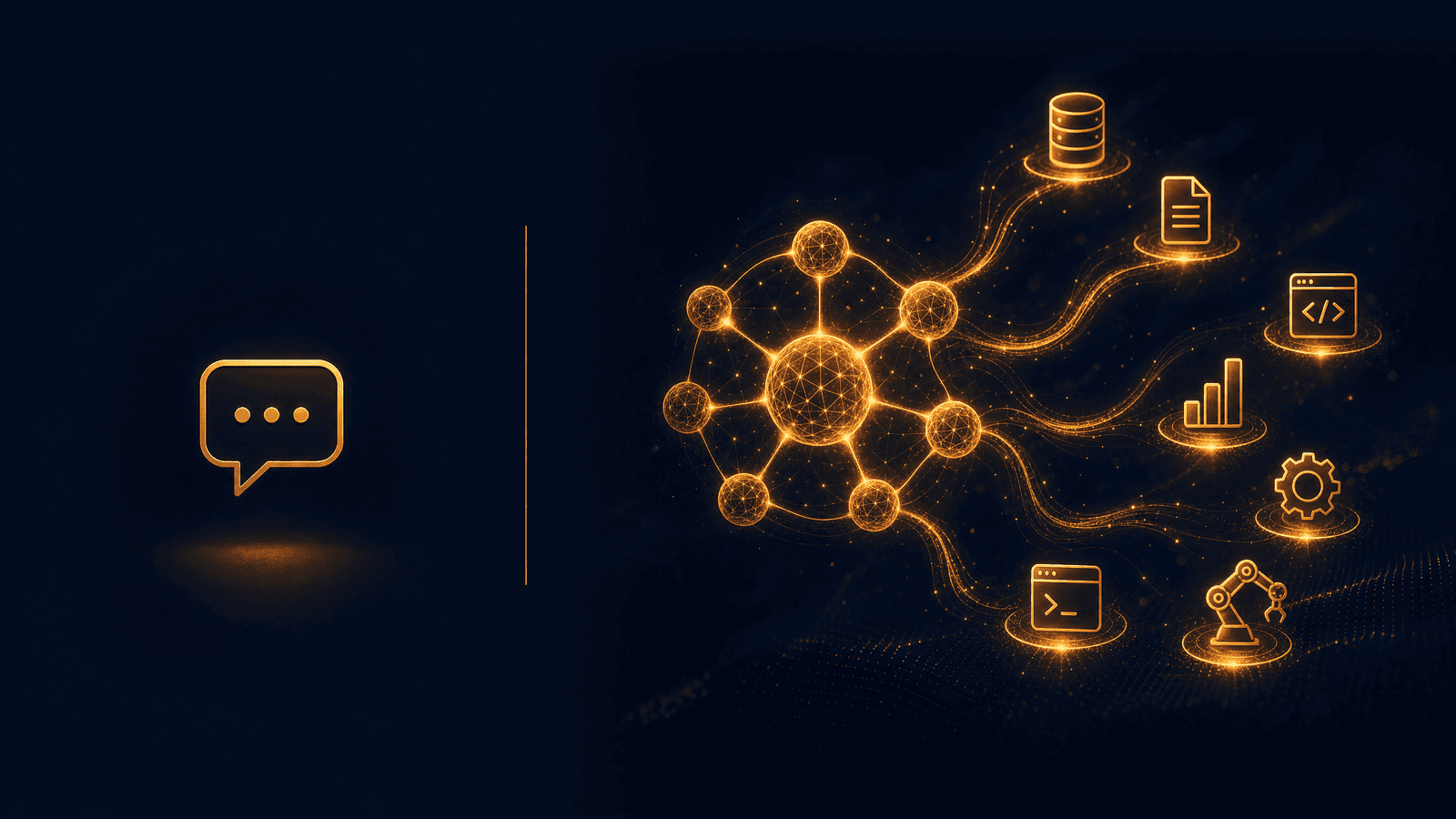
Nine out of ten business owners who reach out asking for "a chatbot" actually need an agent. The two words get used interchangeably, and they should not. A chatbot answers questions. An agent gets work done. The difference shows up the moment a customer asks for something that requires the system to actually do anything, like check a calendar, place an order, look up an account, or follow up tomorrow. If you cannot tell which one you are buying, you are very likely about to spend money on the wrong tool. Here is how to tell them apart and how to know which one fits your business.
What a Chatbot Actually Is
A chatbot, in the classic sense, is a question and answer widget. Customer types a question, the bot looks up an answer from a knowledge base, the answer comes back. That is the entire job. Modern chatbots are smarter than the 2018 versions (they can paraphrase, they can stay on topic, they can route to a human), but at the core they are still a one way information lookup.
Chatbots are the right tool when:
- The customer's main need is information, not action.
- Your business has a stable, well documented knowledge base (policies, FAQs, product details, hours, locations).
- The volume of repetitive questions is high enough that humans answering them is wasteful.
- The questions do not require personalized data to answer ("what is your shipping policy" yes, "where is my specific order" no).
A good example: a citation page for a museum, a documentation site for a software product, a knowledge base for a help center. The user wants to read the right paragraph quickly. A chatbot is the right shape.
What an AI Agent Actually Is
An agent is a system that takes actions on behalf of the user. It can call into your real systems (calendar, CRM, inventory, payment, customer database), hold context across the whole conversation, make decisions about what to do next, and chain multiple steps together to achieve a goal.
The difference is doing, not telling. "What are your hours?" is a chatbot question. "Book me on Thursday at 2 if Dr. Smith has availability and send the intake form to my email" is an agent task. One is information retrieval. The other is a six step workflow.
Agents are the right tool when:
- Your customer's main need is to get something done, not just to know something.
- The work involves looking up account specific information (orders, appointments, history, balance).
- The task changes data somewhere (booking, ordering, updating, canceling).
- There is value in following up across time (the agent remembers you and what was discussed last time).
Why Most Businesses Think They Want a Chatbot
The mismatch happens because "chatbot" has been the default mental model for years. It is the word people know. So when an operator thinks "we need to handle customer questions automatically," they say "we need a chatbot." Then we run discovery and find out the customers are not asking informational questions. They are trying to book, cancel, reorder, change a delivery, check on a claim, get an estimate, or ask about their specific account. None of that is chatbot work. A chatbot will tell them where the booking page is. An agent will book them.
Once you see the distinction, you cannot unsee it. Every "where is my order" question. Every "can you reschedule me." Every "what is my balance." Every "do you have this in stock in size medium." These are all agent jobs. A chatbot will frustrate the customer and make your support load worse, because every conversation ends with the bot saying "I cannot help with that, please contact a human" and the human now has to start from scratch.
The Hybrid That Actually Works
For most businesses the right answer is not "chatbot or agent." It is an agent that has the information lookup capabilities a chatbot would have, plus the ability to do things. The customer never knows the difference. They ask a question, they get an answer or an action, the conversation just works.
The customer facing surface is the same little chat window in the corner of the screen, or the same voice on the phone. The depth behind it is what differs. A real agent can resolve a billing question by actually pulling the account, identifying the issue, and either fixing it or routing to the right human with a clear summary. A chatbot can only point at the FAQ.
When a Chatbot Is Actually the Right Call
To be clear: chatbots are not dead. There are real use cases. Public knowledge bases, where the user is not logged in and the questions are pure information retrieval. Documentation sites and citation pages, where speed and accuracy of lookup beats anything else. Marketing sites where the questions are pre purchase and the action is "go to the form" or "go to the demo." In those situations a focused chatbot beats an over engineered agent.
The trick is being honest about which case you are in. Public site with information seekers? Chatbot is great. Customer portal with account holders trying to get things done? You need an agent.
How to Decide
Three quick questions to figure out which you need.
1. When customers contact you today, what percentage of the requests change something in a system somewhere? If most of them just want information, chatbot. If most want to do something, agent.
2. Does the answer depend on who is asking? If "what is my balance" is a real question your customers ask, you need an agent. Chatbots cannot personalize at that level.
3. Would you want the system to follow up later? Chatbots are stateless. Agents have memory. If the value comes from continuity across multiple touches, agent.
Where to Start
If you want a straight answer on which one fits your business, book a free discovery call. Ten minutes into the conversation we will know which one (or which hybrid) makes sense, and what it would take to ship it.