The owner of a growing P&C insurance agency in California came to us with a familiar problem. His team was drowning. Emails were piling up. Leads were going cold. Calls were being missed. And despite having eight employees, he was still personally handling over 60% of all agency communication.
He did not need more people. He needed to understand where his operation was actually breaking down.
So we plugged in.
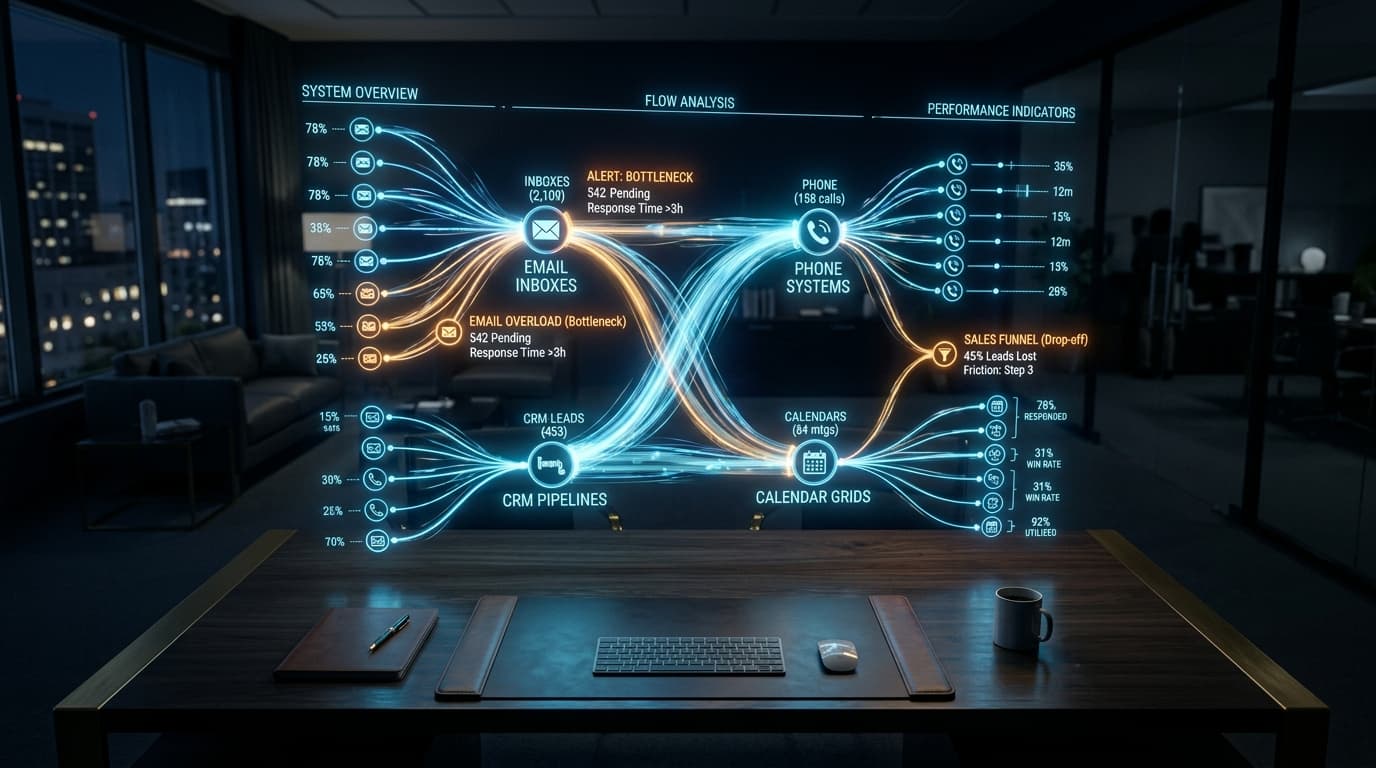
We connected every system his agency runs on. Google Workspace across 16 accounts. RingCentral phone system. AgencyZoom CRM. Dropbox file storage. Calendar. Contacts. All of it feeding into a single unified data layer.
Then we ran a full operational intelligence audit. No changes. No automations. Just observation. We wanted to see everything before we touched anything.
What we found was eye opening.
127,000 Emails and One Overwhelmed Owner
The agency had 127,489 emails across all accounts. The owner's personal mailbox held 77,051 of them. That is 60% of every email the entire agency sends and receives, flowing through one person.
He had 26,670 unread emails. Not because he is disorganized. Because there are not enough hours in the day to process that volume while also running a business, managing a team, and handling clients.
Here is how that email volume broke down by category:
- 10,646 emails related to quotes
- 5,721 emails related to renewals
- 2,430 emails related to cancellations
- 640 emails related to certificate of insurance requests
- 494 emails related to endorsements
- 222 emails related to loss runs
Every single one of those categories has a repeatable pattern. And almost none of them had any automation behind them.
The Carrier Email Problem
A huge portion of the email volume was carrier communication. Policy documents, renewal notices, underwriting questions, commission statements, marketing updates. Multiply that by every carrier the agency is appointed with and it becomes a firehose.
The team was manually reading, sorting, and acting on these emails one at a time. There was no automated classification. No routing. No prioritization. A critical renewal notice from a carrier sat in the same inbox as a marketing newsletter, waiting for a human to find it.
We estimated that carrier email classification and routing alone consumed 10 to 15 hours per week across the team. This is one of the most straightforward automations to implement. An AI classifier can read the email, identify the type (renewal, cancellation, new business, endorsement, billing), extract the policy number and client name, and route it to the right person with the right priority. No human needs to touch it until it is time to take action.
40% of Missed Calls Happen at Lunch
The phone system data told a story nobody expected.
The agency was missing a significant number of calls during a predictable window every single day: the lunch hour. Between 12:00 PM and 1:00 PM, the missed call rate spiked dramatically. Over the period we analyzed, 351 calls went unanswered during lunch.
This was not a staffing problem. It was a coverage problem. The team took lunch at the same time, and the phone system had no fallback routing, no overflow to a secondary team, and no automated callback mechanism.
Each one of those missed calls is a potential client, a current client with a question, or a lead that called once and never called back. At an average policy value of several hundred dollars in annual premium, the revenue impact of 351 missed opportunities is substantial.
The fix is not complicated. Staggered lunch schedules. A simple auto attendant during the lunch window. An automated callback system that texts the caller within 60 seconds saying "We saw you called. A team member will call you back within 15 minutes." These are systems that can be set up in a day.
859 Stale Leads Sitting in the CRM
The CRM had 859 leads that had gone completely cold. No follow up. No status update. No activity. They were created, assigned, and then forgotten.
This is not unusual. It happens in every business that generates more leads than it can manually process. But in insurance, a stale lead is not just a missed sale. It is a missed relationship. Insurance is a retention game. The lifetime value of a client who stays for 5 to 10 years and adds policies over time is enormous compared to the cost of acquiring them.
When we dug into the lead pipeline, the pattern was clear. Leads came in through multiple channels: website forms, carrier referrals, phone calls, and walk ins. They were created in the CRM. But there was no enforced follow up sequence. No automated reminders. No escalation if a lead sat untouched for 48 hours.
The top performing insurance agencies we have studied run a 5 touch sequence within the first 7 days: call, email, text, call, email. Automated. Tracked. With alerts if a lead falls through. This agency had none of that in place.
483 Orphaned Customers
Beyond stale leads, we found 483 existing customers who had no assigned account manager or service representative. These were active policyholders paying premiums with no one specifically responsible for their renewals, cross sell opportunities, or service requests.
Orphaned customers are a ticking clock. When their renewal comes up and nobody reaches out proactively, they are one Google search away from switching to a competitor. When they have a claim and do not know who to call at the agency, their experience suffers. When a life event happens that should trigger a coverage review, nobody is there to initiate it.
The automation here is straightforward: round robin assignment rules in the CRM, triggered by policy type, geography, or premium size. Every customer gets an owner. Every owner gets a renewal calendar. The system alerts before the renewal window opens so the conversation starts early.
The Renewal Pipeline That Was Not a Pipeline
The agency had a concept of a renewal pipeline, but it was not functioning as one. Renewals were tracked in a combination of spreadsheets, CRM notes, and individual memory. There was no centralized view of which renewals were coming up in 30, 60, or 90 days. No automated remarketing triggers. No systematic process for shopping renewals with alternative carriers when the incumbent rate increased.
In insurance, the renewal is the most important moment in the customer relationship. It is the moment the client decides to stay or leave. And it is the moment with the highest leverage for the agency: a retained client costs nothing to acquire, while a lost client costs everything to replace.
We mapped out a renewal automation that pulls policy expiration dates from the management system, creates a task 90 days before expiration, triggers a remarketing workflow if the renewal rate exceeds a threshold, and sends the client a proactive communication explaining their options. The entire sequence runs without manual intervention until a human decision is needed.
The Dashboard Gap
The agency had invested in syncing all of their data into one place. That was the right first step. But the dashboard was primarily a viewing tool. It could show emails, calls, and calendar events. What it could not do was take action.
There was no way to compose and send emails from the dashboard. No way to convert an email into a CRM task with one click. No way to initiate a call through the phone system. No way to see a unified view of a single client showing all their emails, calls, policies, and tasks in one place.
The data was there. The action layer was not. Building that action layer is what transforms a dashboard from a reporting tool into an operations platform.
What We Automated First
Based on the audit, we prioritized three automations that required zero new software, zero new hires, and less than a week of implementation:
1. Carrier email classification and routing. AI reads every incoming carrier email, classifies it by type, extracts the policy number and client name, and routes it to the assigned account manager with the correct priority tag. Estimated time savings: 10 to 15 hours per week.
2. Missed call recovery. When a call goes unanswered, the system automatically sends a text within 60 seconds acknowledging the missed call and promising a callback. The missed call is logged as a task in the CRM assigned to the next available team member. Estimated recovery: hundreds of previously lost touchpoints per month.
3. Lead follow up sequencing. Every new lead entering the CRM triggers an automated 5 touch sequence over 7 days. If the lead does not respond after the sequence, they are tagged for a monthly nurture campaign rather than being forgotten. Estimated impact: hundreds of stale leads re engaged.
These three automations alone returned an estimated 15 to 20 hours per week to the team and recovered a significant number of missed opportunities that were previously invisible.
The Real Time Call Intelligence Layer
One of the most impactful systems we built was a real time call transcription and intelligence layer. Every call through the phone system is automatically transcribed using AI. The transcription is then summarized: who called, what they needed, what was discussed, and what the next steps are.
Before this system, an agent would take a call, scribble notes on a sticky note or maybe type something into the CRM if they had time, and move on to the next call. Critical details were lost. Follow up items were forgotten. If a different team member handled the next interaction with that client, they had no context.
Now, before a team member picks up a call, they can see every previous interaction: what was discussed, what was promised, what is pending. The agent makes the call armed with everything they need. No more scrambling to pull up records while the client waits.
What We Learned
Every small business thinks their problems are unique. And in the details, they are. But the patterns are remarkably consistent.
The owner who handles too much personally. The leads that go stale because nobody is assigned to follow up. The calls that get missed during predictable windows. The carrier communications that get manually sorted hundreds of times per week. The renewal pipeline that exists on paper but does not actually run.
These are not technology problems. They are visibility problems. The data already exists in the systems these businesses use every day. It just has not been connected, analyzed, and automated.
An AI operations audit does not replace anyone. It shows you exactly where your team's time is going, where the leaks are, and which fixes will have the highest impact for the least effort.
For this agency, the first three automations we recommended required zero new software, zero new hires, and less than a week of implementation. The estimated impact: 15 to 20 hours per week returned to the team, hundreds of missed opportunities recovered, and an owner who can finally focus on growing the business instead of routing emails.
Is Your Business Leaking Time and Revenue Without Knowing It?
Every business has these blind spots. The question is whether you find them before they cost you clients.
Our AI operations audit connects to the tools you already use, analyzes your communication patterns, maps your workflows, and delivers a concrete automation playbook with exact triggers, actions, and estimated time savings.
No guessing. No generic advice. Just your data telling you exactly what to fix first.
Get Your Free AI Readiness Assessment or Contact Us to discuss a full operations audit for your business.