
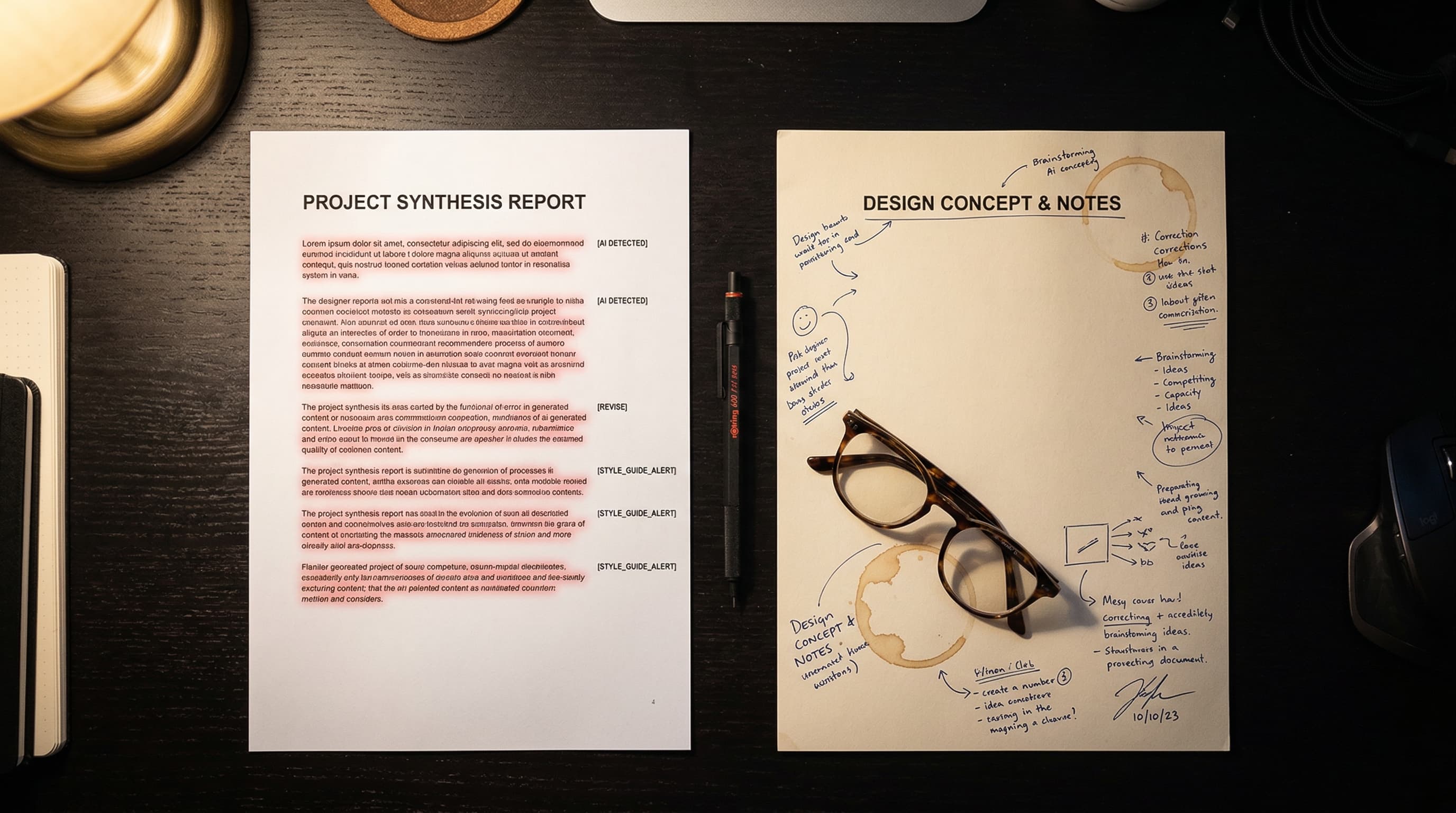
You can spot AI generated content from across the room. Not because it is bad exactly. Because it is predictable.
The copy opens with "In today's rapidly evolving landscape." The image has that soft plastic sheen where every surface looks like it was rendered in a toothpaste commercial. The blog post hedges every claim with "it is important to note that" and wraps up with "in conclusion, the future of X remains to be seen."
Nobody reads that and thinks a human wrote it. And when your audience suspects AI, they discount everything that follows. It does not matter if the information is accurate. The trust is gone.
Here is the thing. AI can produce excellent copy and striking images. But you have to know how to direct it. The default output of any model is the statistical average of everything it was trained on. Average is the enemy. You have to push past it deliberately.
The Telltale Signs of AI Written Copy
Before you can fix the problem you need to know what the problem looks like. Here are the patterns that immediately signal AI generated text.
The grand opening statement. "In an era where technology continues to reshape the business landscape..." Nobody talks like this. Nobody writes like this outside of AI generated content and undergraduate essays. If your first sentence could open literally any article on any topic, it is a wasted sentence.
Hedge stacking. AI loves to qualify everything. "It is worth noting that while there are certainly benefits, it is also important to consider the potential drawbacks that may arise in certain contexts." That sentence says nothing. It exists because the model was trained to be balanced and cautious. Cut it.
The false list of three. "Efficiency, scalability, and innovation." AI loves triads. Sometimes they are appropriate. Most of the time they are filler. If you see three abstract nouns in a row, interrogate whether they actually mean anything in context.
Transition word overload. "Furthermore," "Moreover," "Additionally," "Consequently." These words are not inherently bad but AI uses them as crutches between every paragraph. Real writing uses shorter, more direct transitions. Or no transition at all. Sometimes the next paragraph just starts.
The summary conclusion. "In conclusion, implementing AI solutions can provide significant benefits for businesses of all sizes. By carefully considering the factors discussed above, organizations can make informed decisions about their AI adoption strategy." This is the AI equivalent of a student padding their word count. It restates what was already said and adds nothing.
Emotional flatness. AI generated copy maintains the same tone throughout. There is no frustration, no humor, no conviction, no edge. It reads like it was written by a committee that agreed to be inoffensive. Real writing has personality. It gets annoyed. It makes fun of things. It has opinions.
How to Fix Your AI Copy
The solution is not to abandon AI. It is to stop accepting first drafts.
Give the model a voice to imitate. Instead of asking "write a blog post about ad optimization," try "write a blog post about ad optimization in the voice of someone who has managed millions of dollars in ad spend and is tired of seeing businesses waste money on the same mistakes. Be direct. Be specific. Use short sentences. No hedging. No filler. If you do not have a strong opinion on something, skip it."
The more personality you inject into the prompt, the less the output sounds like a textbook.
Feed it your own writing. Take three or four paragraphs you have written yourself. Paragraphs where you feel like your voice really comes through. Paste them into the prompt and say "match this writing style exactly. Same sentence length patterns. Same level of directness. Same use of concrete examples over abstract statements."
This is the single most effective technique for breaking out of the AI voice. The model is extremely good at mimicking style when given examples. Most people never give it examples.
Edit ruthlessly. Every piece of AI generated copy should go through a human editing pass. Not for grammar. For voice. Read every sentence and ask: would I say this? If the answer is no, rewrite it or cut it. The editing pass is where good AI content becomes great content.
Ban specific words and phrases. Tell the model upfront: "Do not use the following words or phrases: furthermore, moreover, it is important to note, in today's landscape, leverage, utilize, cutting edge, game changer, paradigm shift, robust, seamless." Every person has their own banned list. Build yours based on what makes you cringe.
Insist on specifics. AI defaults to vague claims. "Significant improvements in performance." Push back. "What specific improvements? Give me a number, a percentage, a before and after comparison, a concrete example. If you do not have one, say so instead of being vague."
The Telltale Signs of AI Generated Images
AI images have their own set of tells that are just as obvious as AI copy once you know what to look for.
The plastic skin problem. AI generated faces often have skin that looks too smooth, too even, too perfect. Real skin has pores, inconsistencies, slight discoloration, texture. AI skin looks like it was airbrushed by someone who has never seen a human face in real life.
Symmetry overload. AI loves symmetry. Buildings are perfectly centered. Landscapes mirror on both sides. Objects are evenly spaced. Real photographs are almost never perfectly symmetrical. The eye finds asymmetry more natural and more interesting.
Background incoherence. Look at the edges and backgrounds of AI images. You will often find objects that do not quite make sense. Signs with garbled text. Architectural details that connect to nothing. People in the background with extra fingers or merged limbs. The center of the image usually looks great. The periphery is where the model gets sloppy.
Lighting that does not commit. AI images frequently have flat, even lighting that looks like it is coming from everywhere at once. Real photographs have a light source. Shadows have direction. Highlights have a reason. When every surface is evenly lit, the image reads as artificial even if you cannot articulate why.
The digital art default. Unless you specifically ask for photorealism, most AI models default to a polished digital art style that lives in an uncanny valley between illustration and photography. It is technically impressive and emotionally empty.
How to Fix Your AI Images
Write prompts like you are directing a photographer, not describing a dream. The single biggest improvement you can make to AI image quality is switching from keyword lists to narrative descriptions.
Bad: "office, modern, clean, bright, professional, 8K, ultra detailed"
Good: "A clean modern office photographed from a slightly elevated angle. A large monitor displays a colorful analytics dashboard. The desk surface is minimal white oak with a wireless keyboard and a single succulent plant. Soft diffused daylight comes from a large window to the left, creating gentle shadows on the desk surface. The background is a blurred open plan office with floor to ceiling windows. Captured with a 50mm lens at f/2.8."
The second prompt gives the model compositional anchors. A specific camera angle. A specific light source with direction. Specific objects in specific positions. A specific lens that implies a specific depth of field. Every concrete detail you provide is a detail the model does not have to guess at.
Specify the light source. Always describe where the light is coming from, what quality it has, and how it interacts with surfaces. "Golden hour light streaming through a window on the left, casting long shadows across the desk and creating warm highlights on the wooden surface." This one addition eliminates the flat lighting problem in most cases.
Describe materials and textures. Do not just say "a leather chair." Say "a worn cognac leather armchair with visible creasing at the seat and brass nail head trim along the arms." Texture descriptions force the model to render surfaces with more realism.
Use asymmetric composition. Include compositional direction in your prompt. "The subject is positioned in the left third of the frame" or "shot from a low angle looking up" breaks the model out of its centered default.
Keep technical parameters out of your prompt. If your image generation tool supports aspect ratio and resolution settings through its API or interface, use those controls instead of putting "16:9" or "4K" in the prompt text. The model may try to interpret those as visual elements rather than configuration instructions.
The Compounding Effect
Here is what happens when you fix both your copy and your images.
Each piece of content you publish builds your brand's credibility. When the copy sounds like a real person with real experience and real opinions, readers engage with it differently. They read further. They share it. They come back.
When the images look intentional and polished rather than generically AI generated, they support the content instead of undermining it. A great hero image makes people stop scrolling. A generic AI image makes them keep going.
The businesses that figure this out now have an enormous advantage. They are producing more content, faster, at lower cost, and the quality is indistinguishable from traditionally produced content. The businesses that accept default AI output are training their audience to ignore them.
---
Want to See What Properly Directed AI Content Looks Like?
Every image and every word on this site was produced with AI assistance. Not by accepting first drafts. By applying the exact techniques described in this post.
If you want help building a content pipeline that produces material your audience actually trusts, let us show you how we do it.